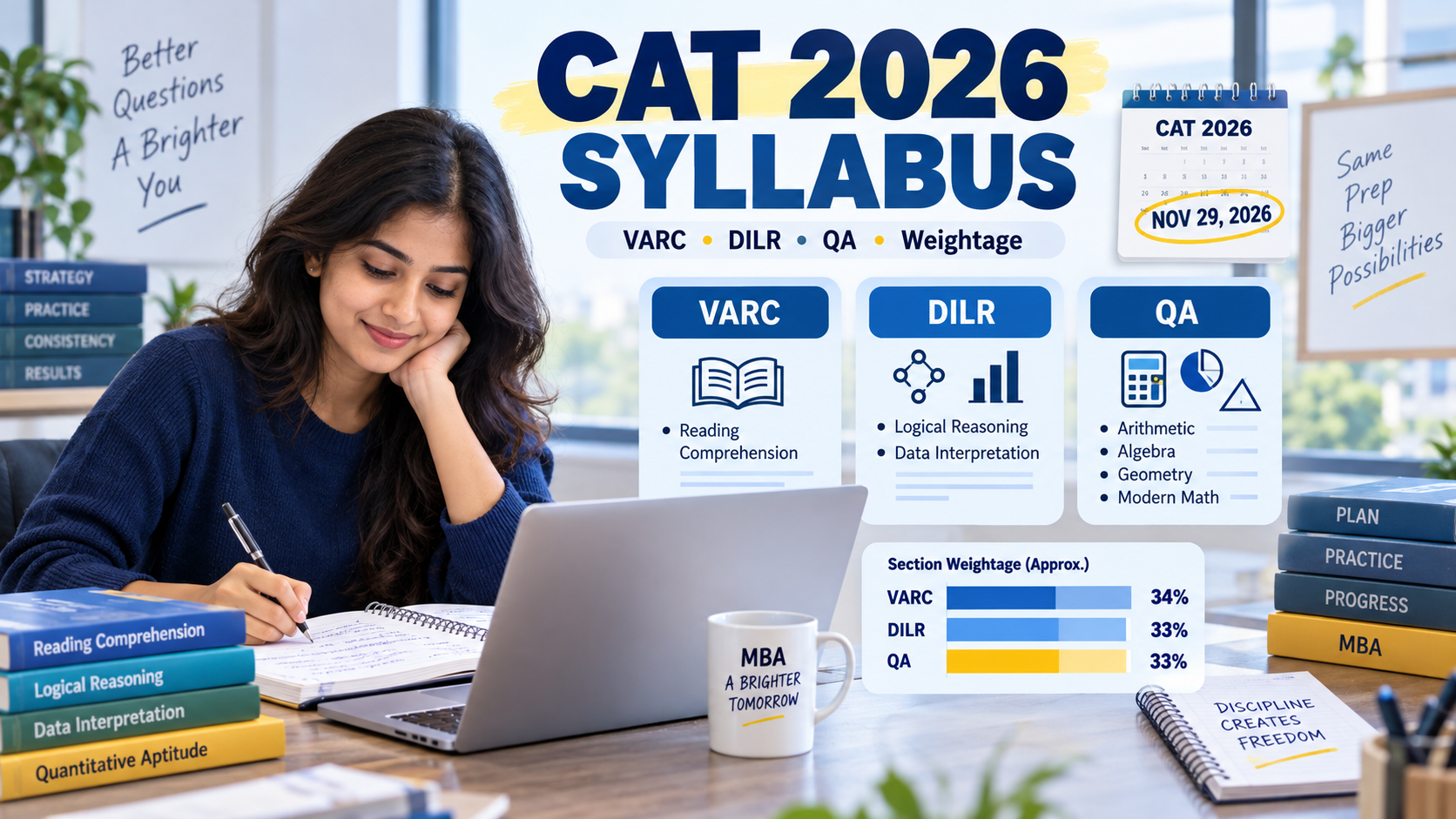
CAT 2026 syllabus covers three sections—Verbal Ability & Reading Comprehension (VARC), Data Interpretation & Logical Reasoning (DILR), and Quantitative Ability (QA). CAT does not come with a detailed chapter-wise syllabus in the official 2026 notice, so preparation is based on the topics and question types repeatedly seen in recent CAT papers. Arithmetic and Algebra deserve the most attention in QA, Reading Comprehension forms the bulk of VARC, while DILR requires practice across different types of sets.
If you’re starting preparation, don’t treat every topic equally. Recent CAT papers show a useful pattern: RC carries the largest share of VARC, Arithmetic and Algebra dominate QA, and DILR rewards your ability to understand and select the right sets rather than memorise a fixed list of puzzle types.
CAT 2026 Syllabus Highlights
Here is the quickest answer to what you need to study for CAT 2026.
| CAT Section | What to Prepare |
|---|---|
| VARC | Reading Comprehension, Para Summary, Para Jumbles, Para Completion, Odd Sentence Out |
| DILR | Tables, charts, caselets, arrangements, ranking, scheduling, distribution, games & tournaments, routes/networks and mixed reasoning sets |
| QA | Arithmetic, Algebra, Geometry & Mensuration, Number Systems, Modern Mathematics |
| Official chapter-wise syllabus | Not provided in the CAT 2026 notice |
| Latest paper reference | CAT 2025 |
| Highest preparation priority | RC in VARC; mixed sets in DILR; Arithmetic + Algebra in QA |
Recent five-year analysis places Arithmetic at about 38% and Algebra at about 34% of QA questions, while Reading Comprehension has continued to make up roughly two-thirds of VARC. These are historical trends—not guaranteed CAT 2026 weightages.
Which CAT topics should you start with?
For most aspirants:
| Section | Start With | Then Move To |
|---|---|---|
| VARC | Reading Comprehension | Para Summary → other VA question types |
| DILR | Basic arrangements + DI caselets | Mixed CAT-style sets → timed set selection |
| QA | Arithmetic | Algebra → Geometry → Number Systems → Modern Maths |
This order is especially useful if your preparation is incomplete and you need to prioritise.
CAT 2026 Syllabus PDF
There is no detailed chapter-wise syllabus PDF issued with the CAT 2026 official notice. The syllabus PDFs available on education and coaching websites are generally created from previous CAT papers and recurring question types.
That does not make them useless. A good syllabus PDF can still help you track preparation—as long as it is clearly presented as a study resource rather than an official IIM syllabus.
Download CAT 2026 Syllabus Checklist
The downloadable checklist for this page includes:
- complete VARC topic checklist;
- DILR set types;
- Arithmetic topics;
- Algebra topics;
- Geometry & Mensuration;
- Number Systems;
- Modern Mathematics;
- preparation-priority map;
- PYQ-readiness tracker; and
- weekly preparation tracker.
Download: CAT 2026 Syllabus Checklist PDF
The checklist is based on recent CAT papers and is meant for preparation tracking. It is not an official IIM syllabus.
CAT 2026 Exam Pattern and Marking Scheme
CAT syllabus tells you what to study; the exam pattern tells you how those topics are tested.
CAT 2026 is officially scheduled as a computer-based test conducted in three sessions. The detailed 2026 paper structure has not been specified in the official notice yet.
The latest completed CAT paper—CAT 2025—provides the best current reference:
| Section | CAT 2025 Questions | Share of Paper |
|---|---|---|
| VARC | 24 | 35.3% |
| DILR | 22 | 32.4% |
| QA | 22 | 32.4% |
| Total | 68 | 100% |
The recent pattern also uses a 120-minute test with 40 minutes per section, with both MCQ and TITA/non-MCQ questions. Current CAT 2026 competitor guides broadly use the 2025 structure as the expected 2026 pattern.
Latest marking scheme reference
| Response | Marks |
|---|---|
| Correct answer | +3 |
| Incorrect MCQ | -1 |
| Incorrect TITA/non-MCQ | No negative marking |
| Unattempted question | 0 |
Treat the question count and marking structure above as the latest CAT pattern reference, not as a newly confirmed CAT 2026 paper specification until the detailed CAT 2026 test instructions become available.
Read more about CAT 2026 Exam Pattern: Sections, Questions, Marks, Duration & Marking Scheme
CAT 2026 Section-Wise Syllabus
The syllabus becomes easier to plan when you break each section into the skills CAT actually tests.
CAT 2026 VARC Syllabus
VARC tests reading comprehension and your ability to understand how ideas are structured, connected and argued.
Recent CAT papers divide VARC into two practical areas:
- Reading Comprehension
- Verbal Ability
CAT 2025 had 16 RC questions and 8 VA questions in each slot, making Reading Comprehension the largest component.
Reading Comprehension syllabus
There are no fixed RC chapters.
Passages can come from:
- philosophy;
- psychology;
- history;
- economics;
- business;
- science;
- technology;
- sociology;
- environment;
- literature;
- politics and public policy;
- anthropology; and
- art and culture.
Recent CAT papers demonstrate how unpredictable the subject matter can be. CAT 2025 included passages around themes such as income inequality, electronic music, artificial intelligence, ecology, tribal artists and dams.
The lesson is simple:
Don’t prepare RC by memorising subject knowledge. Prepare the skills required to understand an unfamiliar passage.
RC question types to practise
You should be comfortable answering questions based on:
- central idea;
- main argument;
- author’s purpose;
- inference;
- author’s tone;
- factual information;
- meaning in context;
- assumption;
- relationship between ideas;
- strengthening or weakening an argument;
- logical conclusion; and
- application of an idea.
What should you actually practise for RC?
Focus on being able to:
- identify what the author is arguing;
- distinguish the author’s view from other viewpoints;
- separate evidence from opinion;
- make only passage-supported inferences;
- understand why a paragraph exists;
- eliminate options that exaggerate the author’s claim;
- handle unfamiliar topics; and
- maintain accuracy under time pressure.
Reading speed helps, but speed without comprehension is rarely useful.
CAT 2026 Verbal Ability Syllabus
Recent CAT papers focus primarily on paragraph-based reasoning rather than direct grammar or vocabulary questions.
| Topic | What It Tests |
|---|---|
| Para Summary | Identifying the central meaning of a paragraph |
| Para Jumbles | Arranging sentences into a logical sequence |
| Para Completion | Understanding where an idea logically fits |
| Odd Sentence Out | Finding the sentence that breaks paragraph coherence |
Para Summary, Para Jumbles, Paragraph Completion and Odd Sentence questions have appeared in recent CAT papers.
Does CAT ask direct grammar or vocabulary questions?
Recent CAT papers have not had a separate vocabulary or grammar subsection.
You still need a reasonable command of English to understand RCs and VA questions, but spending weeks memorising vocabulary lists should not replace:
RC practice → paragraph logic → VA practice
CAT 2026 DILR Syllabus
DILR tests whether you can organise information, understand constraints and solve a group of related questions efficiently.
Unlike QA, DILR does not fit neatly into a fixed chapter list.
A single set can combine:
- numerical data;
- several conditions;
- arrangements;
- calculations;
- ranking; and
- logical deductions.
That is why solving complete CAT-style sets matters more than merely learning names of reasoning topics.
CAT Data Interpretation topics
Prepare sets involving:
- tables;
- bar graphs;
- line graphs;
- pie charts;
- scatter plots;
- data caselets;
- percentage comparisons;
- ratios;
- growth/change;
- missing data;
- ranking data;
- mixed graphs;
- data tabulation; and
- logic-based DI.
Five-year CAT analysis shows both conventional Data Interpretation and increasingly prominent logic-based DI appearing across recent papers.
CAT Logical Reasoning topics
Practise:
- linear arrangements;
- circular arrangements;
- ranking and ordering;
- scheduling;
- selection;
- distribution;
- grouping;
- teams;
- games and tournaments;
- routes and networks;
- assignment problems;
- sets and Venn diagrams;
- conditional reasoning;
- binary logic;
- quant-based reasoning;
- mathematical reasoning; and
- mixed puzzles.
Why DILR can’t be prepared as a simple chapter list
Suppose a set gives you six employees, their departments, performance ratings and four conditions about how they can be ranked.
Is that:
- ranking?
- arrangement?
- distribution?
- DI?
- logical reasoning?
It could be all of them.
CAT frequently mixes these structures, which is why recognising the logic of an unfamiliar set is more valuable than memorising 30 named puzzle categories.
DILR topics you should not over-prioritise
Some broad aptitude syllabi include:
- clocks;
- calendars;
- basic coding-decoding;
- standalone blood relations;
- elementary direction sense; and
- simple syllogisms.
These concepts aren’t impossible in CAT, but recent papers are far more centred on multi-question sets.
Don’t spend disproportionate preparation time solving hundreds of easy standalone reasoning questions while avoiding actual CAT sets.
The hidden DILR topic: set selection
One of the most important DILR skills is never listed in a syllabus:
choosing which set to solve.
When a test begins, ask:
- Do I understand this set?
- Is there a clear starting point?
- Can the information be organised quickly?
- Are enough conditions definite?
- Am I making progress?
- Would another set be easier?
CAT aspirants regularly report being able to solve difficult sets during practice but struggling to reproduce that performance in mocks. That gap is often about selection and time pressure, not just concept knowledge.
CAT 2026 Quantitative Ability Syllabus
CAT QA is mainly built around Arithmetic, Algebra, Geometry & Mensuration, Number Systems and Modern Mathematics.
Of the three CAT sections, Quant has the clearest conventional syllabus.
Recent five-year analysis shows that Arithmetic and Algebra together account for about 72% of QA questions, making them the most important areas to complete first.
CAT Arithmetic syllabus
Prepare:
- percentages;
- ratio and proportion;
- averages;
- profit and loss;
- discount;
- simple interest;
- compound interest;
- mixtures and alligation;
- partnership;
- time and work;
- pipes and cisterns;
- time, speed and distance;
- relative speed;
- trains; and
- boats and races.
Why Arithmetic should usually come first
Arithmetic accounted for approximately 38% of QA questions in the CAT 2021–2025 dataset analysed by MBAUniverse, the largest share among the major Quant areas.
If maths is your weakest section, Arithmetic gives you a much better foundation than jumping randomly between chapters.
CAT Algebra syllabus
Prepare:
- linear equations;
- quadratic equations;
- polynomials;
- inequalities;
- functions;
- graphs;
- logarithms;
- exponents;
- surds and indices;
- modulus;
- sequences and series;
- arithmetic progression;
- geometric progression; and
- maxima and minima.
Algebra contributed approximately 34% of QA questions in the same five-year analysis.
For most aspirants:
Arithmetic + Algebra should form the core of Quant preparation.
CAT Geometry and Mensuration syllabus
Prepare:
- lines and angles;
- triangles;
- quadrilaterals;
- polygons;
- circles;
- similarity;
- congruence;
- coordinate geometry;
- area and perimeter;
- 2D mensuration;
- 3D mensuration;
- surface area; and
- volume.
Geometry and Mensuration accounted for approximately 15% of QA questions in the 2021–2025 analysis.
Focus first on the relationships and concepts that repeatedly appear in CAT questions instead of memorising every possible theorem.
CAT Number Systems syllabus
Prepare:
- divisibility;
- factors and multiples;
- HCF and LCM;
- remainders;
- unit and last digits;
- number properties;
- integers;
- factorials;
- base systems; and
- related surds/indices concepts.
Number Systems contributed approximately 8% of QA questions in the five-year dataset.
CAT Modern Mathematics syllabus
Prepare:
- permutations and combinations;
- probability;
- set theory;
- basic combinatorics; and
- relevant sequence/series applications.
Modern Mathematics accounted for approximately 5% of QA questions in the same analysis.
That doesn’t mean you should skip it.
It means:
If Arithmetic and Algebra are still weak, fixing those areas will usually give you a better return than spending the same amount of time on a low-frequency Modern Maths topic.
CAT 2026 Topic-Wise Weightage
CAT 2026 does not have an officially fixed topic-wise weightage. Use past weightage to decide preparation priority—not to predict the exact number of questions you will get.
QA Weightage: CAT 2021–2025 Trend
| QA Area | Approx. Share |
|---|---|
| Arithmetic | 38% |
| Algebra | 34% |
| Geometry & Mensuration | 15% |
| Number Systems | 8% |
| Modern Mathematics | 5% |
Source: Five-year CAT question analysis
What this means for QA preparation
If your syllabus is incomplete:
Arithmetic → Algebra → Geometry → Number Systems → Modern Mathematics
is a sensible order.
It does not mean a student who has completed Arithmetic and Algebra should ignore everything else.
VARC Weightage
Recent CAT papers have given approximately:
| VARC Area | Recent Share |
|---|---|
| Reading Comprehension | ~67% |
| Verbal Ability | ~33% |
CAT 2025 had 16 RC and 8 VA questions in each slot.
This is why RC deserves consistent practice throughout your preparation.
DILR Weightage
A five-year classification of recent CAT sets places Logical Reasoning at around 55% and Data Interpretation at around 45%.
However, don’t read too much into that split.
Modern CAT sets regularly combine DI and LR, so set diversity is more useful than trying to divide your preparation into an exact 55:45 ratio.
Most Important Topics for CAT 2026
If your preparation time is limited, use this as a priority map.
| Priority | VARC | DILR | QA |
|---|---|---|---|
| Tier 1 | Reading Comprehension | Mixed CAT-style sets + set selection | Arithmetic, Algebra |
| Tier 2 | Para Summary, paragraph logic | Arrangements, DI caselets, distribution | Geometry & Mensuration |
| Tier 3 | Para Completion, Para Jumbles, Odd Sentence | Games, scheduling, networks | Number Systems |
| Tier 4 | Timed mixed practice | Unfamiliar set structures | Modern Mathematics |
This is a preparation priority based on recent CAT trends, not an official CAT weightage table.
CAT 2025 Paper Analysis: What Should CAT 2026 Aspirants Learn?
CAT 2025 is currently the closest completed CAT paper, so it is more useful for preparation than blindly following an old syllabus list.
VARC
Across CAT 2025 slots:
- VARC had 24 questions;
- Reading Comprehension remained the largest component;
- Para Summary appeared;
- Para Jumbles appeared;
- Paragraph Completion appeared; and
- Odd Sentence questions appeared.
Takeaway: RC should remain part of your daily or regular preparation rather than being treated as one chapter to finish.
DILR
Recent papers continue to use varied sets based on combinations of:
- data;
- arrangements;
- graphs;
- rankings;
- mathematical reasoning;
- logical conditions; and
- caselets.
Takeaway: don’t expect CAT 2026 to present DILR as a predictable sequence of textbook puzzle types.
QA
Arithmetic and Algebra remain the strongest multi-year QA areas.
Takeaway: if your Quant syllabus is incomplete, strengthening these two areas should usually come before trying to cover every minor topic superficially.
Has the CAT 2026 Syllabus Changed?
No new chapter-wise syllabus has been announced for CAT 2026.
The practical preparation framework therefore continues to revolve around:
- VARC;
- DILR; and
- QA.
Syllabus change vs paper-pattern change
These are not the same thing.
If CAT changes:
- question count;
- MCQ/TITA distribution;
- difficulty;
- section composition; or
- topic weightage
that does not necessarily mean the syllabus itself has changed.
Similarly, a topic appearing more frequently in one year doesn’t make it a guaranteed high-weightage CAT 2026 topic.
Be cautious of statements such as:
“CAT 2026 will definitely have seven Arithmetic questions.”
Use trends for preparation—not prediction.
How to Use the CAT 2026 Syllabus Without Getting Overwhelmed
Most aspirants don’t struggle because they can’t find the syllabus.
They struggle because they don’t know when a topic is actually complete.
Current CAT 2026 discussions repeatedly show students saying they have “finished Arithmetic” but still cannot solve Arithmetic questions during mocks, or that they know concepts but fail to apply them under test conditions.
Don’t measure preparation only by chapters completed
Use four stages:
| Stage | What It Means |
|---|---|
| Not started | You haven’t learnt the concept |
| Concept covered | You understand the method but struggle with CAT-level application |
| PYQ ready | You can solve recent CAT questions from the topic independently |
| Test ready | You can recognise and solve the topic under sectional/mock pressure |
This distinction matters.
Example: Percentages
Suppose you’ve watched all your Percentage lectures and can solve basic exercises.
Then a CAT PYQ combines percentages with ratios and you can’t find the approach.
Percentages should not be marked “done”.
You’re at:
Concept covered → PYQ readiness pending
That gives you a much more realistic picture of your preparation.
Best Order to Complete the CAT 2026 Syllabus
There is no single order that works for everyone, but recent-paper weightage gives you a sensible default.
QA preparation order
Start with:
Arithmetic → Algebra → Geometry → Number Systems → Modern Mathematics
If you are already strong in one area, adjust accordingly.
VARC preparation order
Don’t try to complete VARC in isolated blocks.
Run:
RC throughout preparation + VA practice alongside it
Reading comprehension improves through repeated exposure rather than one-time syllabus completion.
DILR preparation order
Progress through:
basic set structures → varied sets → mixed sets → timed sectionals → set selection
Don’t wait until you have theoretically “finished DILR” before solving full sets.
Students preparing for CAT 2026 commonly report that practice and mock performance lag behind concept coverage, especially in DILR and QA.
CAT 2026 Preparation Strategy After Syllabus Coverage
Once you know the major concepts, preparation should gradually move away from lectures and towards application.
Use this progression:
- Topic-wise practice
- CAT previous-year questions
- Mixed-topic questions
- Sectional tests
- Full mocks
- Mock analysis
- Revision of repeated mistakes
Should you finish the entire CAT syllabus before starting mocks?
No.
Waiting for 100% syllabus completion can delay the skills that mocks are designed to develop:
- question selection;
- time allocation;
- accuracy under pressure;
- knowing when to leave a question;
- set selection in DILR;
- RC decision-making; and
- recovery after a difficult section.
Current CAT aspirants frequently ask whether they should finish remaining topics first or begin mocks alongside them—the better approach for most students is to do both once the basic foundation is in place.
What should you analyse after a mock?
Don’t only note the score.
Ask:
- Which easy questions did I miss?
- Where did I waste time?
- Which topics could I not recognise?
- Which mistakes were conceptual?
- Which mistakes were calculation errors?
- Which DILR set should I have attempted first?
- Did I answer an RC question without enough evidence?
- Which unattempted questions were actually solvable?
A mock without analysis tells you your score.
A mock with analysis tells you what to fix.
CAT 2026 Syllabus Checklist
Use this checklist while preparing.
VARC
- □ Reading Comprehension
- □ Main Idea
- □ Inference
- □ Author’s Tone
- □ Argument/Purpose
- □ Para Summary
- □ Para Completion
- □ Para Jumbles
- □ Odd Sentence Out
DILR
- □ Tables
- □ Charts and graphs
- □ Caselets
- □ Linear arrangements
- □ Circular arrangements
- □ Ranking
- □ Selection and distribution
- □ Scheduling
- □ Games and tournaments
- □ Routes and networks
- □ Groups/teams
- □ Venn/set relationships
- □ Conditional reasoning
- □ Quant-based reasoning
- □ Mixed DI-LR sets
- □ Set selection
QA — Arithmetic
- □ Percentages
- □ Ratio and proportion
- □ Averages
- □ Profit and loss
- □ Discount
- □ Simple and Compound Interest
- □ Mixtures and alligation
- □ Partnership
- □ Time and work
- □ Pipes and cisterns
- □ Time, speed and distance
QA — Algebra
- □ Linear equations
- □ Quadratic equations
- □ Polynomials
- □ Inequalities
- □ Functions
- □ Graphs
- □ Logarithms
- □ Surds and indices
- □ Modulus
- □ Sequences and series
- □ AP and GP
- □ Maxima and minima
QA — Geometry & Mensuration
- □ Lines and angles
- □ Triangles
- □ Quadrilaterals
- □ Polygons
- □ Circles
- □ Coordinate geometry
- □ Similarity and congruence
- □ 2D mensuration
- □ 3D mensuration
QA — Number Systems
- □ Divisibility
- □ Factors and multiples
- □ HCF and LCM
- □ Remainders
- □ Last digits
- □ Number properties
- □ Factorials
- □ Base systems
QA — Modern Mathematics
- □ Permutations and combinations
- □ Probability
- □ Set theory
- □ Basic combinatorics
Download the printable checklist
CAT 2026 Syllabus Checklist PDF
The downloadable version also includes the four-stage preparation tracker and a weekly progress sheet.
Best Books for CAT 2026 Syllabus Preparation
You don’t need several books for the same topic.
A better approach is:
one concept source + CAT-level practice + PYQs + mocks
| Section | Commonly Used Resource |
|---|---|
| VARC | How to Prepare for Verbal Ability and Reading Comprehension for CAT — Arun Sharma & Meenakshi Upadhyay |
| DILR | How to Prepare for Data Interpretation for CAT — Arun Sharma |
| DILR | Logical Reasoning and Data Interpretation for CAT — Nishit K. Sinha |
| QA | How to Prepare for Quantitative Aptitude for CAT — Arun Sharma |
| QA | Quantum CAT — Sarvesh K. Verma |
| All sections | Recent CAT previous-year question papers |
Students often keep adding resources when what they actually need is more practice. CAT preparation discussions repeatedly emphasise PYQs, mocks and analysis once concepts are understood.
How do you know when to stop studying a topic from a book?
Move on when you can:
- understand the core concept;
- solve standard CAT-level questions;
- handle recent PYQs independently; and
- recognise the topic during a timed test.
You can always return during revision.
CAT Syllabus vs XAT, SNAP and NMAT
CAT aspirants often prepare for more than one management entrance exam.
| Exam | Broad Difference from CAT |
|---|---|
| CAT | VARC + DILR + QA |
| XAT | CAT-like aptitude areas plus Decision Making and additional exam-specific components |
| SNAP | Shorter, speed-focused aptitude test |
| NMAT | Language Skills, Quantitative Skills and Logical Reasoning with a different test format |
There is substantial overlap in verbal, Quant and reasoning preparation, but each exam has its own structure and should be prepared using its latest official pattern.
Don’t assume that finishing CAT automatically means you have completed the full syllabus of every other MBA entrance exam.
CAT 2026 Syllabus FAQs
Is the CAT syllabus different for engineers and non-engineers?
No. Candidates from engineering, commerce, humanities, science and other academic backgrounds take the same CAT paper.
What changes is your starting point, not the syllabus. Someone comfortable with maths may spend comparatively more time on VARC, while another student may need more QA foundation work.
Can CAT 2026 be prepared through self-study?
Yes. Coaching is not compulsory for CAT preparation.
Self-study works best when you have:
- a clear topic plan;
- reliable concept resources;
- recent CAT PYQs;
- sectional tests;
- a good mock series; and
- a consistent mock-analysis routine.
The bigger risk with self-study isn’t the lack of content—there is plenty available. It is preparing without feedback or a structured testing schedule.
Is NCERT Maths enough for CAT Quant?
NCERT or school-level maths can help rebuild fundamentals, especially if your basics are weak.
It is not sufficient by itself for CAT because CAT tests application and question selection under time pressure.
Once fundamentals are clear, move to:
CAT-level questions → PYQs → sectionals → mocks
Does CAT 2026 have a General Knowledge section?
CAT has not used a separate GK/Current Affairs section in its established VARC-DILR-QA structure.
This is one reason you should not use the syllabus of exams such as XAT interchangeably with CAT.
I’m working full-time and my syllabus is still incomplete. What should I prioritise?
Don’t try to complete every low-frequency topic at the same depth.
Prioritise:
- Arithmetic and Algebra in QA;
- regular RC practice;
- varied DILR sets;
- PYQs;
- sectionals; and
- mocks.
Working CAT 2026 aspirants frequently report the same problem: major topics are partially covered but mock consistency and remaining syllabus become difficult to balance.
At this stage, test-readiness matters more than the percentage of your syllabus you’ve technically “covered.”