
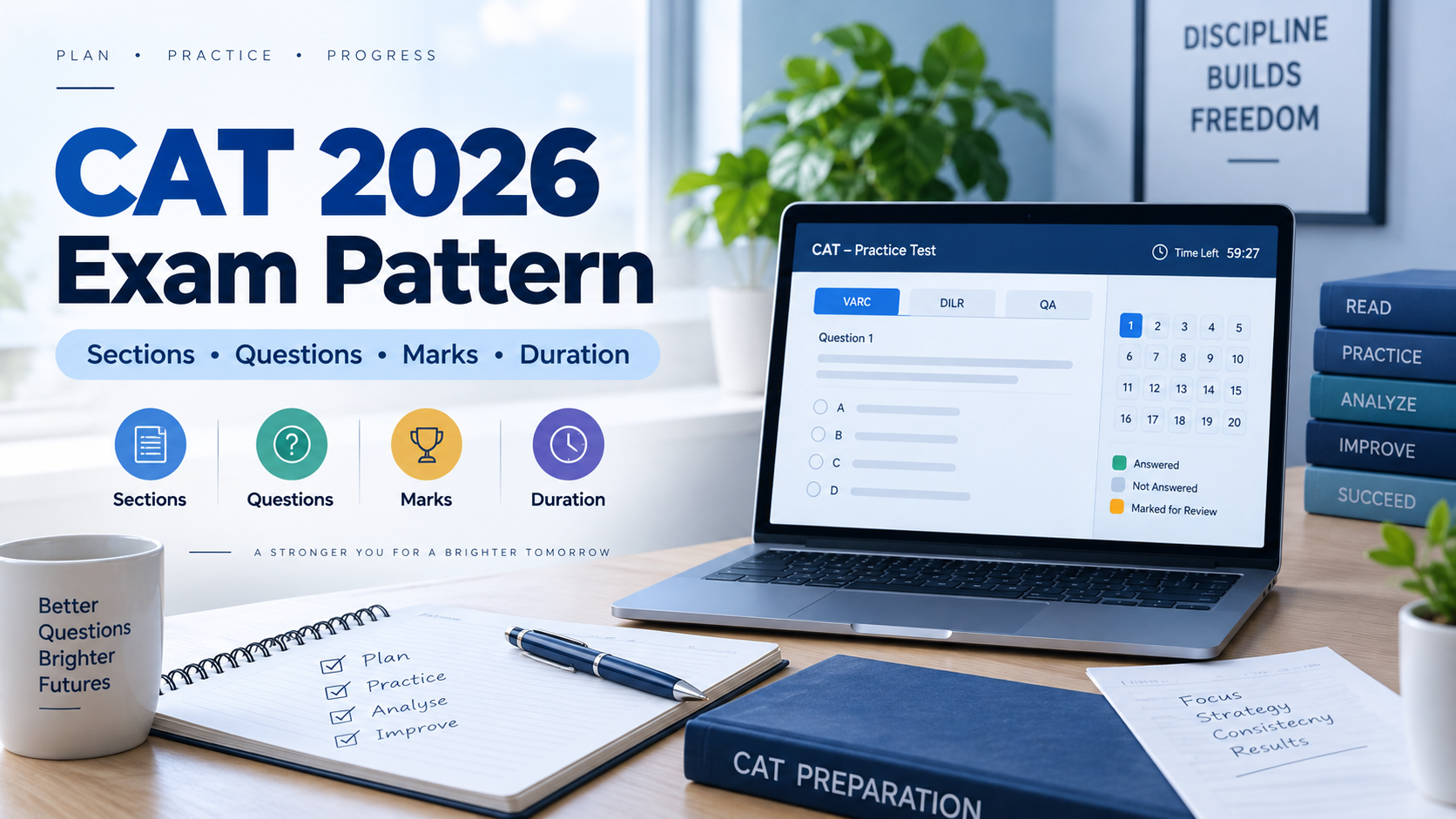
CAT 2026 will be conducted as a computer-based test on November 29, 2026, in three sessions. For preparation, candidates should currently work with the recent CAT format of three sections—VARC, DILR and QA—68 questions, 120 minutes and 40 minutes per section. The detailed CAT 2026 question count and MCQ/TITA distribution have not yet been specified in the official notice, so those figures should be treated as the latest-paper benchmark rather than a guaranteed 2026 structure.
CAT 2026 Exam Pattern: Quick Overview
If you only want to understand how the CAT 2026 paper is expected to look, start here.
| Particular | CAT 2026 |
|---|---|
| Exam mode | Computer-Based Test |
| Number of sections | 3 |
| Sections | VARC, DILR, QA |
| Expected total questions | 68 |
| Expected total marks | 204 |
| Expected exam duration | 120 minutes |
| Expected sectional time | 40 minutes each |
| Question types | MCQ + TITA/Non-MCQ |
| Correct answer | +3 marks |
| Incorrect MCQ | -1 mark |
| Incorrect TITA | No negative marking |
| Section order | VARC → DILR → QA |
| Exam sessions | 3 — officially confirmed |
| CAT 2026 exam date | November 29, 2026 |
Source: The official CAT 2026 notice confirms the computer-based exam, November 29 test date and three-session format. The 68-question, 120-minute and +3/-1 structure reflects the latest CAT paper pattern and is the current preparation benchmark.
CAT 2026 Section-Wise Exam Pattern
Based on CAT 2025, candidates should prepare for 68 questions divided across VARC, DILR and QA.
| Section | Expected Questions | Expected Marks | Time |
|---|---|---|---|
| Verbal Ability & Reading Comprehension (VARC) | 24 | 72 | 40 min |
| Data Interpretation & Logical Reasoning (DILR) | 22 | 66 | 40 min |
| Quantitative Ability (QA) | 22 | 66 | 40 min |
| Total | 68 | 204 | 120 min |
CAT 2024 and CAT 2025 both used the 68-question structure after CAT had used 66 questions from 2021 to 2023.
CAT VARC Exam Pattern
VARC comes first and, based on the latest pattern, contains 24 questions in 40 minutes.
| VARC Detail | Latest Pattern |
|---|---|
| Questions | 24 |
| Time | 40 minutes |
| Maximum marks | 72 |
| Reading Comprehension | 16 questions in CAT 2025 |
| Verbal Ability | 8 questions in CAT 2025 |
Recent CAT VARC has been RC-heavy. CAT 2025 had four Reading Comprehension passages carrying 16 questions, with the remaining eight questions coming from Verbal Ability.
What kinds of questions appear in VARC?
The recent pattern includes:
- Reading Comprehension
- Para Summary
- Para Completion
- Para Jumbles
- Odd Sentence Out
For the complete topic list rather than paper structure, refer to CAT 2026 Syllabus.
What does the VARC pattern mean in practice?
Twenty-four questions in 40 minutes doesn’t mean you should divide the time equally across 24 questions.
RC questions come with the additional cost of reading a passage. A more useful skill is deciding:
- which RC to read first;
- whether a passage is worth continuing;
- when two options are too close to guess;
- how much time to leave for VA; and
- when to move on from a difficult question.
Unused VARC time cannot be transferred to DILR under the recent CAT format.
CAT DILR Exam Pattern
DILR comes second and has had 22 questions in 40 minutes in CAT 2024 and CAT 2025.
| DILR Detail | Latest Pattern |
|---|---|
| Questions | 22 |
| Time | 40 minutes |
| Maximum marks | 66 |
| Main format | Multi-question sets |
| Question types | MCQ + TITA |
CAT 2025 used five sets containing four or five questions each, with combinations of Data Interpretation and Logical Reasoning.
Why the number of questions doesn’t tell the full DILR story
DILR is not really 22 independent questions.
Suppose one four-question set takes five minutes to understand and another takes ten minutes before you even make the first useful deduction.
Those four questions do not have the same time cost.
That’s why the actual DILR exam pattern is better understood as:
40 minutes + several sets + a set-selection problem
rather than simply “22 questions”.
Current CAT aspirants repeatedly report that DILR performance swings widely between mocks because of set selection and the ability to recognise the right approach quickly.
CAT QA Exam Pattern
QA is the final section and has recently contained 22 questions in 40 minutes.
| QA Detail | Latest Pattern |
|---|---|
| Questions | 22 |
| Time | 40 minutes |
| Maximum marks | 66 |
| Question types | MCQ + TITA |
| Main areas | Arithmetic, Algebra, Geometry, Number Systems, Modern Maths |
Arithmetic and Algebra have been the most prominent QA areas across recent CAT papers, but the exam-pattern page should not duplicate the entire syllabus. See CAT 2026 Syllabus for the topic-wise breakdown and weightage analysis.
What the QA pattern really tests
The 40-minute limit makes question selection important.
You have to identify:
- questions you can solve immediately;
- questions requiring lengthy calculations;
- questions worth returning to;
- questions where options can help; and
- questions that should simply be left.
CAT does not reward you for spending eight minutes proving that you could eventually solve one difficult problem.
How Many Questions Are There in CAT 2026?
Candidates should currently prepare for 68 questions—24 in VARC, 22 in DILR and 22 in QA. However, the official CAT 2026 notice has not yet specified the final question count.
The 68-question format was used in both CAT 2024 and CAT 2025, making it the strongest current benchmark for 2026.
Expected CAT 2026 question distribution
| Section | Questions |
|---|---|
| VARC | 24 |
| DILR | 22 |
| QA | 22 |
| Total | 68 |
CAT 2026 Marking Scheme
The latest CAT marking scheme awards +3 marks for every correct answer, deducts 1 mark for an incorrect MCQ and does not apply negative marking to an incorrect TITA/non-MCQ answer.
| Response | MCQ | TITA |
|---|---|---|
| Correct | +3 | +3 |
| Incorrect | -1 | 0 |
| Unattempted | 0 | 0 |
This marking system is consistently reflected in current CAT 2026 pattern references and recent CAT papers.
MCQ vs TITA: what is the difference?
MCQ
An MCQ provides answer choices.
A wrong answer costs 1 mark.
TITA
TITA means Type In The Answer.
Instead of selecting an option, you enter the answer.
A wrong TITA carries no negative mark in the recent CAT marking scheme.
CAT score calculation example
Suppose you get:
- 30 questions correct;
- 6 MCQs wrong;
- 4 TITA questions wrong.
Your raw score would be:
30 × 3 = 90
MCQ penalty:
6 × -1 = -6
Wrong TITA penalty:
0
Raw score = 84
Should you attempt every TITA because there is no negative marking?
Not necessarily. A wrong TITA doesn’t cost marks, but solving it can still cost time. A seven-minute TITA attempt that produces zero marks may prevent you from attempting two easier questions. So think of TITA like this:
Low scoring risk does not mean zero opportunity cost.
CAT 2026 Exam Duration and Sectional Time Limit
The recent CAT format gives 120 minutes overall, divided into three separate 40-minute sections.
| Section | Time |
|---|---|
| VARC | 40 minutes |
| DILR | 40 minutes |
| QA | 40 minutes |
| Total | 120 minutes |
The 40-minute sectional structure has remained in place across recent CAT editions.
Can you switch between CAT sections?
Under the recent CAT format, no. The order is:
VARC → DILR → QA
Once the VARC timer expires, the section closes and you move to DILR.
You cannot:
- begin with QA;
- return to VARC later;
- transfer unused VARC time to DILR; or
- save minutes for QA.
You can navigate among questions within the currently active section.
What happens if you finish a section early?
You still don’t receive extra time in the next section. This makes a CAT sectional test fundamentally different from an exam where you can distribute the total 120 minutes however you want.
Time limit for PwD candidates
Recent CAT instructions have provided 53 minutes 20 seconds per section for eligible PwD candidates, giving 160 minutes overall.
| Section | Standard | Recent PwD Pattern |
|---|---|---|
| VARC | 40 min | 53 min 20 sec |
| DILR | 40 min | 53 min 20 sec |
| QA | 40 min | 53 min 20 sec |
| Total | 120 min | 160 min |
Eligible candidates should check the final CAT 2026 test-day instructions for the applicable accommodation.
CAT 2026 Slot Timings
CAT 2026 is officially confirmed to be conducted in three sessions, but the CAT 2026 notice does not specify the exact start and end time of each session. Recent CAT exams have commonly used:
| Session | Recent CAT Timing |
|---|---|
| Morning | 8:30 AM–10:30 AM |
| Afternoon | 12:30 PM–2:30 PM |
| Evening | 4:30 PM–6:30 PM |
Your actual reporting time and exam session should be taken from the CAT 2026 admit card and final test-day instructions.
What Type of Questions Are Asked in CAT?
CAT uses two main question formats:
MCQ — select an answer from the available choices.
TITA/non-MCQ — type the answer into the answer field.
But the more useful distinction is how questions are organised within each section:
| Section | Typical Question Structure |
|---|---|
| VARC | RC passages + standalone VA questions |
| DILR | Multi-question sets |
| QA | Standalone quantitative problems |
This makes “number of questions per minute” a poor way to plan the entire CAT paper.
For example, 22 DILR questions may be packaged inside just a handful of sets, while QA consists largely of individual questions.
How the CAT Computer-Based Test Works
CAT is a computer-based test taken at a designated test centre, not an exam taken from home.
Recent CAT interfaces include:
- question palette;
- countdown timer;
- Save & Next;
- Mark for Review & Next;
- Clear Response;
- MCQ selection;
- typed answers for non-MCQs; and
- an on-screen calculator.
Older official CAT mock-navigation documentation confirms the use of functions such as Save & Next, Mark for Review, Clear Response and typed answers for non-MCQs.
Is a calculator allowed in CAT?
Recent CAT interfaces provide an on-screen calculator. External physical calculators are not part of the normal CAT test setup. Career Launcher’s current pattern guide also includes the on-screen calculator among the established interface features. That doesn’t mean you should use it for every calculation.
Mental calculation is often faster for:
- simple percentages;
- ratios;
- approximations; and
- basic multiplication/division.
What to Check When the CAT 2026 Official Mock Is Released
This is one of the most important updates CollegeShastra should make later in the cycle. The official mock/test instructions can confirm details that the current CAT 2026 notice does not.
Check:
| Detail | What to Verify |
|---|---|
| Total questions | Whether 68 continues |
| Section-wise breakup | VARC/DILR/QA question counts |
| Sectional timing | Whether 40 minutes continues |
| MCQ/TITA mix | Actual format shown |
| Navigation | Section and question movement rules |
| Calculator | Availability/function |
| Marking instructions | Exact penalties |
| PwD timing | Final accommodation |
| Interface | Any button/navigation changes |
CAT 2026 Total Marks
If CAT 2026 follows the recent 68-question pattern, the maximum raw score will be 204 marks.
Calculation:
68 questions × 3 marks = 204
This is why current CAT pattern pages refer to 204 total marks.
However, the final 2026 maximum depends on the final question count.
If IIMs change the number of questions, total raw marks would change accordingly.
CAT Raw Score, Scaled Score and Percentile
These are not the same thing.
Raw score
Your score from correct and incorrect answers using the marking scheme.
Scaled score
CAT is conducted in multiple sessions with different question papers.
Scores are normalised/scaled to account for differences in paper difficulty across slots. Current CAT pattern references also explain that slot variation is adjusted before percentile computation.
Percentile
Percentile indicates your performance relative to other CAT candidates.
A 99 percentile does not mean 99% marks.
It means your performance is above approximately 99% of the relevant candidate population after the CAT scoring process.
How many marks are needed for 99 percentile in CAT 2026?
There is no fixed CAT 2026 mark for 99 percentile before the exam.
It depends on:
- paper difficulty;
- slot difficulty;
- candidate performance; and
- normalisation.
How Has the CAT Exam Pattern Changed Over the Years?
CAT has changed considerably from the 100-question, three-hour paper used before 2020.
| CAT Year | Questions | Duration |
|---|---|---|
| 2019 | 100 | 180 min |
| 2020 | 76 | 120 min |
| 2021 | 66 | 120 min |
| 2022 | 66 | 120 min |
| 2023 | 66 | 120 min |
| 2024 | 68 | 120 min |
| 2025 | 68 | 120 min |
| 2026 | 68 expected | 120 min expected |
Recent historical pattern analyses consistently show the transition from 100 questions in 2019 to 76 in 2020, 66 during 2021–2023 and 68 in 2024–2025.
What has remained relatively stable?
The recent CAT structure has centred on:
- VARC;
- DILR;
- QA;
- a two-hour paper;
- sectional timing;
- MCQs + TITA questions; and
- negative marking only for incorrect MCQs.
Question counts have changed before, so don’t treat 68 as something CAT can never change.
CAT 2026 Exam Pattern vs CAT 2025
No CAT 2026 paper-pattern change has been formally announced so far.
| Feature | CAT 2025 | CAT 2026 Current Position |
|---|---|---|
| Sections | VARC, DILR, QA | Expected same |
| Questions | 68 | Expected 68 |
| VARC | 24 | Expected similar |
| DILR | 22 | Expected similar |
| QA | 22 | Expected similar |
| Duration | 120 min | Expected same |
| Sectional time | 40 min | Expected same |
| MCQ + TITA | Yes | Expected same |
| +3/-1 scheme | Yes | Expected same |
| Sessions | 3 | Confirmed for 2026 |
The safest preparation strategy is therefore to practise the CAT 2025 structure now and adjust only if the official 2026 mock or instructions change something.
CAT Exam Pattern vs CAT Syllabus
These are closely related but answer different questions.
| CAT Exam Pattern | CAT Syllabus |
|---|---|
| How many sections? | What topics should I study? |
| How many questions? | Which topics fall under each section? |
| How much time? | Which chapters/question types recur? |
| MCQ or TITA? | What skills are tested? |
| What is the marking scheme? | What should I prioritise? |
| Can I switch sections? | What content should I practise? |
For the full section-wise topic list, recent weightage trends and preparation checklist, read CAT 2026 Syllabus.
CAT vs XAT vs SNAP vs NMAT: Exam Pattern
CAT isn’t simply “another MBA exam”. The structure changes how you need to manage time.
| Feature | CAT | XAT | SNAP | NMAT |
|---|---|---|---|---|
| Main CAT-like areas | VARC, DILR, QA | Verbal, DM, QA-DI + other components | English, reasoning, Quant/DI/DS | Language, Quant, LR |
| Strict sectional timing | Yes | Different structure | No CAT-style 40-min lock | Sectional timing structure |
| Negative marking | MCQ wrong | Yes | Yes | No |
| CAT-style TITA | Yes | Different format | No | No |
| Multiple attempts | Once/year | Once/year | Multiple test opportunities | Multiple opportunities depending on cycle |
How to Prepare According to the CAT 2026 Exam Pattern
Knowing the format only helps if it changes how you practise.
Treat CAT as three 40-minute tests
Instead of thinking:
“I have two hours.”
Train yourself to think:
40 minutes VARC → reset → 40 minutes DILR → reset → 40 minutes QA
This matters because one bad section cannot be rescued by borrowing time from another.
Use a 40-minute readiness check
For each section, track four things:
| Skill | Question to Ask |
|---|---|
| Recognition | Can I quickly identify solvable questions/sets? |
| Selection | Am I choosing the right questions first? |
| Execution | Can I solve them accurately? |
| Exit discipline | Can I leave a bad question/set before it wastes my section? |
This is a more useful measure than simply counting how many chapters you have completed.
Analyse selection mistakes separately
After every mock, classify errors as:
| Error Type | Example |
|---|---|
| Concept error | Didn’t know the method |
| Reading error | Misread a condition |
| Calculation error | Approach correct, arithmetic wrong |
| Selection error | Chose the wrong DILR set |
| Time error | Stayed too long on one question |
| Risk error | Guessed an MCQ without enough basis |
| Fatigue error | QA performance dropped after VARC + DILR |
Recent CAT aspirants repeatedly describe mock scores dropping because of set choice, time pressure or a bad section affecting the next one—not simply because they hadn’t studied the underlying topic.
That’s why mock analysis is part of learning the exam pattern, not something separate from it.
CAT 2026 Exam Pattern FAQs
Is CAT an adaptive exam?
No. CAT is not a question-by-question adaptive test like some computer-based examinations where the difficulty changes according to each response. Candidates in a slot receive the relevant CAT question paper and choose which questions to attempt within the active section.
Is there a minimum number of questions I must attempt in CAT?
No fixed minimum attempt count is prescribed. You can leave questions unanswered without a negative mark under the recent marking scheme. A sensible attempt count depends on:
- paper difficulty;
- your accuracy;
- your strengths; and
- the questions available in your slot.
Does CAT have a pass mark?
CAT does not work like a board examination with one universal pass mark. Candidates receive scores and percentiles, while individual IIMs and other institutes apply their own shortlisting criteria, including overall and sometimes sectional percentile requirements.
Are all three CAT sections compulsory?
All three sections form part of the CAT paper. Even if one section is your weakness, ignoring it completely can be risky because individual institutes may use sectional percentile requirements during shortlisting.
Does a wrong TITA answer reduce my CAT percentile?
A wrong TITA does not attract a negative mark under the recent CAT marking scheme. It can only affect your result through the marks you did not earn and the time spent on the question. Percentile is determined from your eventual CAT scoring performance relative to other candidates.
Are CAT questions the same in all three slots?
No. CAT is conducted in different sessions with different question papers. That is why CAT uses a normalisation/scaling process before percentile calculation.