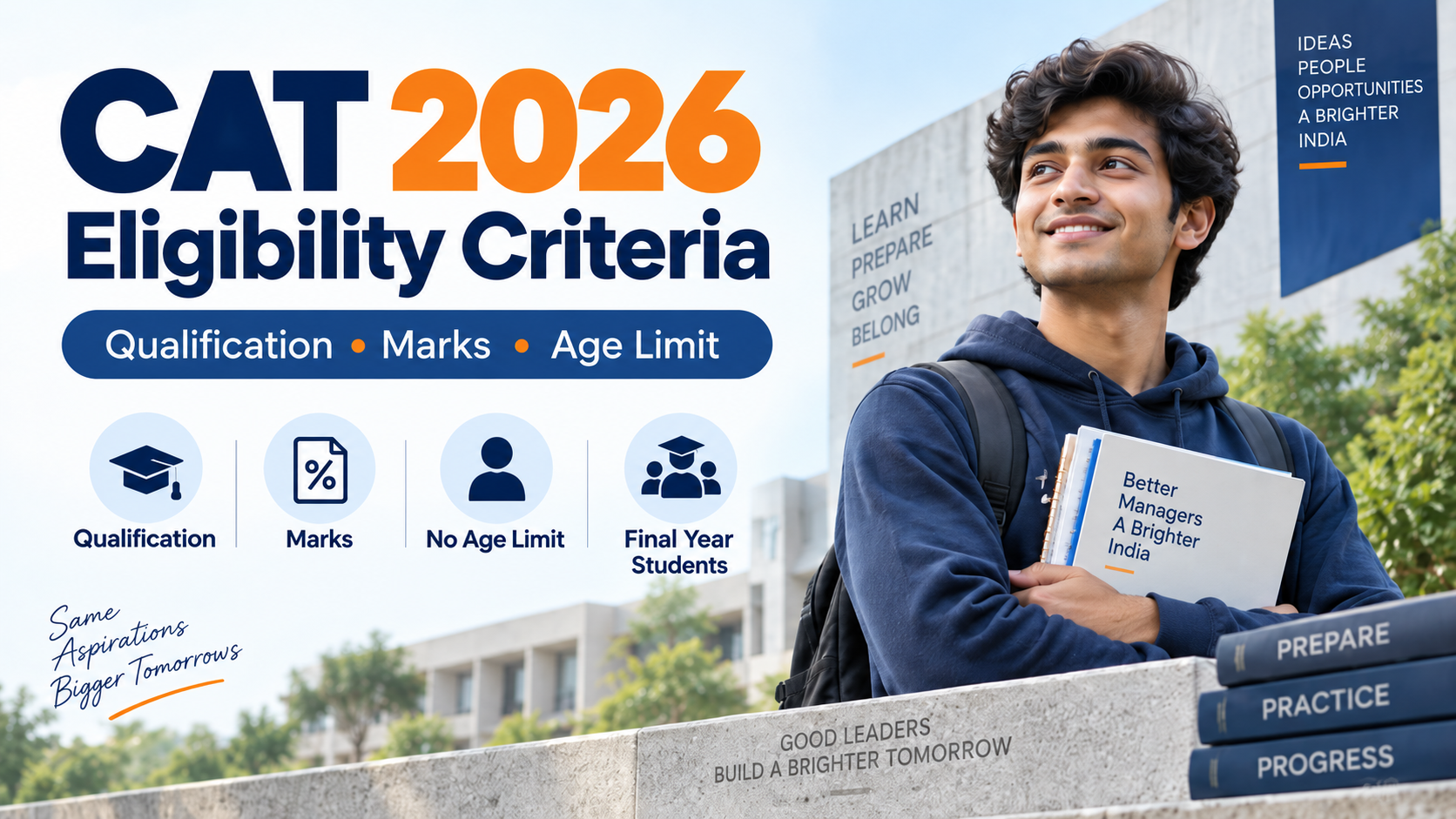
CAT 2026 eligibility criteria require candidates to have a recognised bachelor’s degree with at least 50% marks or equivalent CGPA. The minimum qualifying marks are 45% for SC, ST and PwBD candidates. Students in the final year of graduation and candidates who have completed their degree requirements but are waiting for results can also apply.
Candidates who have completed professional qualifications such as CA, CS, ICWA/CMA or Fellow of the Institute of Actuaries of India (FIAI) can also apply if they meet the prescribed marks requirement. CAT 2026 does not prescribe an age limit, work-experience requirement or a fixed number of attempts.
CAT 2026 Eligibility Criteria: Overview
The basic CAT eligibility requirements are related to the candidate’s graduation or eligible professional qualification. General, EWS and NC-OBC candidates need at least 50% marks or equivalent CGPA, while SC, ST and PwBD candidates need at least 45%. Final-year bachelor’s students are allowed to register provisionally.
| Eligibility Factor | CAT 2026 Requirement |
|---|---|
| Minimum qualification | Bachelor’s degree or eligible professional qualification |
| General/EWS/NC-OBC | Minimum 50% marks or equivalent CGPA |
| SC/ST/PwBD | Minimum 45% marks or equivalent CGPA |
| Final-year students | Eligible |
| Candidates awaiting graduation results | Eligible |
| Graduation stream | Any recognised discipline |
| Professional qualifications | CA, CS, ICWA/CMA or FIAI |
| Age limit | No age limit prescribed |
| Number of attempts | No attempt limit prescribed |
| Work experience | Not required |
Meeting the minimum CAT eligibility criteria only makes a candidate eligible to take the examination. It does not guarantee an IIM shortlist or admission, since individual IIMs follow their own programme eligibility, shortlisting and selection criteria.
Source: CAT 2026 Information Bulletin (Official)
CAT 2026 Educational Qualification and Minimum Marks
Candidates must have a recognised bachelor’s degree or an eligible professional qualification to apply for CAT 2026. Students who are still in the final year of their bachelor’s degree can also register, subject to completing the degree requirements within the prescribed admission timeline.
A candidate can meet the educational qualification requirement through any of the following routes:
- Completed a recognised bachelor’s degree with the required percentage.
- Be studying in the final year of a recognised bachelor’s degree.
- Have completed the bachelor’s degree requirements and be awaiting the final result.
- Have completed an eligible professional qualification such as CA, CS, CMA/ICWA or FIAI.
The bachelor’s degree should be awarded by a recognised university or educational institution, or be an equivalent qualification recognised under the applicable Ministry of Education rules.
CAT 2026 Minimum Marks by Category
The minimum marks depend on the candidate’s category. General, EWS and NC-OBC candidates need at least 50% marks or equivalent CGPA, while SC, ST and PwBD candidates need at least 45%.
| Category | Minimum Marks/Equivalent CGPA |
|---|---|
| General | 50% |
| EWS | 50% |
| NC-OBC | 50% |
| SC | 45% |
| ST | 45% |
| PwBD | 45% |
Candidates should calculate their graduation percentage according to the method followed by their university or institution. An independent or unofficial conversion method should not be used if the university already provides an official formula.
Source: CAT 2026 Information Bulletin (Official)
Which Graduation Streams Are Eligible for CAT?
CAT 2026 is open to graduates from any recognised academic stream. There is no requirement to have studied Commerce, Management or Engineering to appear for the exam.
Candidates from the following backgrounds can apply if they meet the qualification and marks requirements:
- Engineering and Technology
- Commerce and Accounting
- Arts and Humanities
- Science
- Management
- Law
- Medicine and Allied Sciences
- Agriculture
- Other recognised undergraduate disciplines
The graduation stream itself does not determine CAT eligibility. The main requirement is that the degree is recognised and the candidate has secured the prescribed minimum marks.
Source: CAT 2026 Information Bulletin (Official)
How Is CGPA Converted Into Percentage for CAT?
If a university awards grades or CGPA instead of percentage marks, candidates must use the conversion method officially certified by that university or institution.
If the university confirms that it does not have a CGPA-to-percentage conversion scheme, CAT specifies the following method:
Percentage = (CGPA ÷ Maximum Possible CGPA) × 100
For example, a candidate with 7.6 CGPA on a 10-point scale would have an equivalent percentage of 76% under this method, provided the university does not prescribe another conversion formula.
Candidates should therefore check their university’s official conversion rule before entering their graduation percentage in the CAT application form.
Source: CAT 2026 Information Bulletin (Official)
CAT 2026 Eligibility for Final-Year Students and Candidates Awaiting Results
Yes, final-year graduation students can apply for CAT 2026. Candidates who have completed all the requirements of their degree but whose final result has not yet been declared are also eligible to register.
Such candidates can appear for CAT provisionally, but they must ultimately complete the qualifying degree and satisfy the required percentage before the deadline prescribed by the admitting IIM.
Final-year and result-awaiting candidates should keep the following points in mind:
- They can register for CAT 2026 before receiving the final degree.
- Academic details entered in the application should match the latest official university records available.
- If selected by an IIM, proof of degree completion may have to be submitted later.
- The institute may ask for a certificate from the Principal or Registrar confirming that all degree requirements have been completed.
- Final admission remains subject to meeting the degree-completion and marks requirements.
The final deadline for submitting graduation proof is decided by the respective IIM, so candidates should check the admission policy of the institute to which they are applying.
Source: CAT 2026 Information Bulletin (Official)
Can Students With Backlogs Apply for CAT 2026?
A backlog does not automatically make a student ineligible for CAT 2026. A final-year candidate with a pending subject can generally register if they otherwise satisfy the CAT eligibility conditions.
The important issue is whether the candidate will be able to complete the bachelor’s degree and meet the required marks before the admission deadline.
Students with backlogs should check:
- whether the supplementary or backlog examination will be conducted in time;
- when the university is expected to declare the revised result;
- whether clearing the backlog will complete all degree requirements;
- whether the final percentage will meet the CAT eligibility threshold; and
- whether the degree can be completed before the admitting IIM’s deadline.
Candidates should enter only the marks or CGPA supported by their current official records while filling the application. Future or expected marks should not be estimated.
Source: CAT 2026 Information Bulletin (Official)
CAT 2026 Eligibility for CA, CS, CMA/ICWA and FIAI Candidates
Candidates who have completed certain recognised professional qualifications can also apply for CAT 2026. This route is useful for candidates who hold a professional qualification in addition to, or instead of relying on, the regular bachelor’s-degree route.
The eligible professional qualifications include:
- Chartered Accountancy (CA)
- Company Secretary (CS)
- Cost and Management Accountancy — CMA/ICWA
- Fellow of the Institute of Actuaries of India (FIAI)
The minimum qualifying marks remain:
- 50% for General, EWS and NC-OBC candidates
- 45% for SC, ST and PwBD candidates
The professional qualification should be completed. A candidate who is only pursuing CA, CS, CMA or another professional qualification cannot rely on that qualification alone unless another eligible route, such as a recognised bachelor’s degree, has already been satisfied.
Source: CAT 2026 Information Bulletin (Official)
CAT 2026 Age Limit, Attempts, Work Experience and Gap Years
CAT 2026 does not prescribe a maximum age limit, number-of-attempt restriction or mandatory work-experience requirement. Candidates can therefore take CAT whether they are fresh graduates, working professionals or graduates returning to studies after several years.
The main rules are:
- Age limit: No maximum age limit is prescribed.
- Minimum age: No separate minimum age is specified beyond satisfying the educational qualification requirement.
- Number of attempts: There is no fixed limit on CAT attempts.
- Work experience: Not required to appear for CAT.
- Career gap: Does not make a candidate ineligible.
- Academic gap: Does not by itself affect basic CAT eligibility.
Work experience and gap years may still become relevant during the admission process. Some IIMs give weightage to work experience, while interview panels may ask candidates about longer academic or career gaps.
These factors therefore need to be viewed separately:
For CAT eligibility: Age, work experience and gap years do not prevent an otherwise eligible candidate from taking the exam.
For IIM admission: Work experience and academic profile may influence shortlisting or final selection depending on the institute.
Source: CAT 2026 Official Website and CAT 2026 Information Bulletin
CAT 2026 Category-Wise Eligibility
The candidate’s category affects the minimum marks required in the qualifying degree. General, EWS and NC-OBC candidates require at least 50%, while SC, ST and PwBD candidates require at least 45%.
The key category-wise eligibility points are:
- General: Minimum 50% marks or equivalent CGPA.
- EWS: Minimum 50% marks or equivalent CGPA.
- NC-OBC: Minimum 50% marks or equivalent CGPA.
- SC: Minimum 45% marks or equivalent CGPA.
- ST: Minimum 45% marks or equivalent CGPA.
- PwBD: Minimum 45% marks or equivalent CGPA.
The 45% relaxation applies to the academic eligibility requirement for SC, ST and PwBD candidates. It should not be confused with reservation in IIM admissions, which is a separate part of the admission process.
Candidates claiming a reserved category should also ensure that their supporting certificates meet the format and validity requirements applicable to CAT 2026. Incorrect or invalid category documentation can affect the category claim during verification.
Source: CAT 2026 Information Bulletin (Official)
Who Is Not Eligible for CAT 2026?
Candidates who do not meet the prescribed academic qualification or minimum marks requirement are not eligible for CAT 2026. Class 12 qualification or a diploma alone is not sufficient unless the candidate also satisfies one of the recognised degree or professional-qualification routes.
A candidate may not meet the CAT 2026 eligibility criteria in the following cases:
- General, EWS or NC-OBC candidate has less than 50% in the qualifying degree.
- SC, ST or PwBD candidate has less than 45%.
- Candidate has only completed Class 12.
- Candidate holds only a diploma without an eligible bachelor’s degree.
- Candidate is not yet in the final year of a qualifying bachelor’s programme.
- Candidate is relying on CA, CS, CMA/ICWA or FIAI but has not completed the qualification.
- Degree or qualification does not meet the applicable recognition requirements.
- Final-year candidate fails to complete the degree within the admission timeline.
IIMs can verify academic and category eligibility at different stages of the admission process. Candidates should therefore provide accurate information during CAT registration and ensure that it can be supported by official documents later.
Source: CAT 2026 Information Bulletin (Official)
CAT Eligibility vs IIM Admission Eligibility
CAT eligibility and IIM admission eligibility are not the same thing. CAT eligibility primarily determines whether a candidate can register for and appear in the examination. Once CAT results are declared, every IIM can apply its own academic cutoffs, CAT percentile requirements, sectional cutoffs and selection criteria.
For example, CAT does not prescribe minimum Class 10 or Class 12 marks simply for taking the examination. Individual IIMs, however, may consider school marks, graduation performance, CAT scores, work experience, academic diversity, gender diversity and interview performance while shortlisting or selecting candidates.
| CAT Eligibility | IIM Admission/Shortlisting |
|---|---|
| Determines whether a candidate can take CAT | Determines whether a candidate may be shortlisted/admitted |
| Based mainly on qualifying degree and marks | CAT percentile and sectional cutoffs may apply |
| Class 10/12 marks do not decide CAT exam eligibility | Some IIMs consider Class 10/12 marks |
| Work experience is not required | Some IIMs award weightage for work experience |
| No academic-diversity requirement to take CAT | Some IIMs award academic-diversity points |
| No gender-diversity requirement to take CAT | Some institutes give diversity weightage |
This means a candidate can be fully eligible to write CAT but may not meet the admission or shortlisting criteria of every IIM. Candidates should therefore check the admission policy of each institute separately instead of assuming CAT eligibility automatically makes them eligible for every MBA programme.
Source: CAT 2026 Information Bulletin (Official)
CAT 2026 Eligibility Check: Common Cases
The following examples provide a quick way to understand how the CAT eligibility criteria apply in common situations.
| Candidate Situation | CAT 2026 Eligibility | Key Condition |
|---|---|---|
| BTech graduate with 60% | Eligible | Recognised degree |
| BCom graduate with 52% | Eligible | Recognised degree |
| General candidate with 48% graduation | Not eligible | Minimum required is 50% |
| SC candidate with 47% graduation | Eligible | Minimum required is 45% |
| Final-year BBA student | Eligible | Degree must be completed later |
| Final-year student with a backlog | Can apply subject to completion | Backlog must not prevent degree completion |
| Degree completed but result awaited | Eligible | Proof required later if selected |
| Completed CA with required marks | Eligible | Professional qualification completed |
| Pursuing CA with no eligible bachelor’s route | Not eligible through CA route yet | Qualification must be completed |
| Candidate aged above 30 | Eligible | No age bar prescribed |
| Candidate with a career gap | Eligible | Gap does not affect basic CAT eligibility |
| Class 12 student | Not eligible | Bachelor’s-level eligibility not yet reached |
| Diploma holder without bachelor’s degree | Not eligible on diploma alone | Eligible qualifying degree required |
These examples are based on the CAT 2026 eligibility conditions and should be read along with the official rules in unusual or borderline academic cases.
Source: CAT 2026 Information Bulletin (Official)
Documents to Check Before Applying for CAT 2026
Candidates should ensure that the academic and category information entered in the CAT application matches their official records. Graduation marksheets, degree or provisional degree certificates and the university’s CGPA conversion method should therefore be checked before filling the form.
The main records worth checking are:
- graduation marksheets available so far;
- degree or provisional degree certificate, if already graduated;
- university’s official CGPA-to-percentage conversion rule, where applicable;
- latest marks available for final-year students;
- relevant category or PwBD certificate; and
- Principal/Registrar certificate when required later for provisional admission.
Final-year students should use their currently available academic records, while candidates claiming category benefits should make sure the relevant certificate meets the requirements applicable to CAT 2026. Check CAT 2026 Documents Required for Registration: Complete Checklist
Eligibility can be verified at different stages of the CAT and IIM selection process, so discrepancies between the application and official documents can create problems later.
Source: CAT 2026 Information Bulletin (Official)
Also Read:
CAT 2026 Syllabus: VARC, DILR & QA Topics, Weightage
CAT 2026 Exam Pattern: Sections, Questions, Marks, Duration & Marking Scheme
CAT Previous Year Question Papers 2025–2017: Slot-wise PYQs with Solutions
CAT 2026 Eligibility Criteria FAQs
Is a distance or online bachelor’s degree valid for CAT 2026?
A distance or online bachelor’s degree can satisfy the CAT qualification requirement if the degree and institution have the required recognition for the relevant academic session. Candidates studying through online or distance mode should verify the recognition status of their programme rather than assuming that every online qualification is automatically accepted.
Source: UGC Distance Education Bureau
I have 49.9% in graduation. Can I round it to 50% for CAT?
Candidates should report the percentage calculated according to the method followed by their university or institution. CAT specifies how percentage should be determined when CGPA is awarded, but candidates should not independently alter an officially calculated percentage simply to meet the eligibility threshold.
If the official record is very close to 50%, it is advisable to confirm the calculation with the university or CAT helpdesk before applying.
Can a postgraduate candidate apply for CAT 2026?
Yes. Having a master’s degree does not prevent a candidate from taking CAT. However, the postgraduate degree does not replace the basic qualifying requirement if the candidate has not otherwise fulfilled one of the eligibility routes prescribed by CAT.
Does a low Class 10 or Class 12 percentage make me ineligible for CAT?
No minimum Class 10 or Class 12 percentage is prescribed for appearing in CAT 2026. School marks may still matter later because individual IIMs can include Class 10 and Class 12 performance in their shortlisting or admission criteria.
Can a candidate with a foreign bachelor’s degree apply for CAT?
A candidate with an overseas qualification should establish that the qualification meets the equivalence requirements applicable to CAT and the institute to which admission is sought. Since foreign-degree equivalence can depend on the qualification and awarding institution, such candidates should confirm their specific case through the CAT helpdesk and the admission office of their target IIM.
Can I apply for CAT if my final graduation result has not been declared?
Yes. Candidates who have completed their degree requirements but are awaiting results can apply for CAT 2026. If selected for an IIM programme, they will later need to satisfy the institute’s documentation and degree-completion requirements within the prescribed deadline.