
CAT 2026 preparation should include concept building, regular question practice, previous-year papers, sectional tests and mock tests. Candidates should first understand where they stand in VARC, DILR and Quantitative Ability and then plan their preparation around their strong and weak areas.
A good CAT preparation plan moves gradually from learning concepts to solving questions within a time limit and taking full-length mocks. The aim is not to finish every available book or solve every difficult question. What matters more is improving accuracy, speed, question selection and consistency.
How to Prepare for CAT 2026: 6 Steps to Start
The first step in CAT preparation is to understand the exam and find out which sections need the most work. This prevents students from spending too much time on topics they already know while weaker areas remain untouched.
Start with these six steps:
- Understand the CAT syllabus and exam pattern.
- Take a mock test or solve a previous-year paper to check your current level.
- Separate topics into strong, average and weak areas.
- Learn concepts and practise questions alongside them.
- Start sectional tests and full-length mocks as your preparation improves.
- Keep a note of your mistakes and revise them regularly.
Do not worry about scoring well in the first mock. Use it to understand where you are losing marks. You may find that your concepts are weak in one section, you are taking too long to solve questions in another, or you are attempting too many questions and losing marks because of low accuracy.
Understand the CAT 2026 Exam Pattern and Syllabus
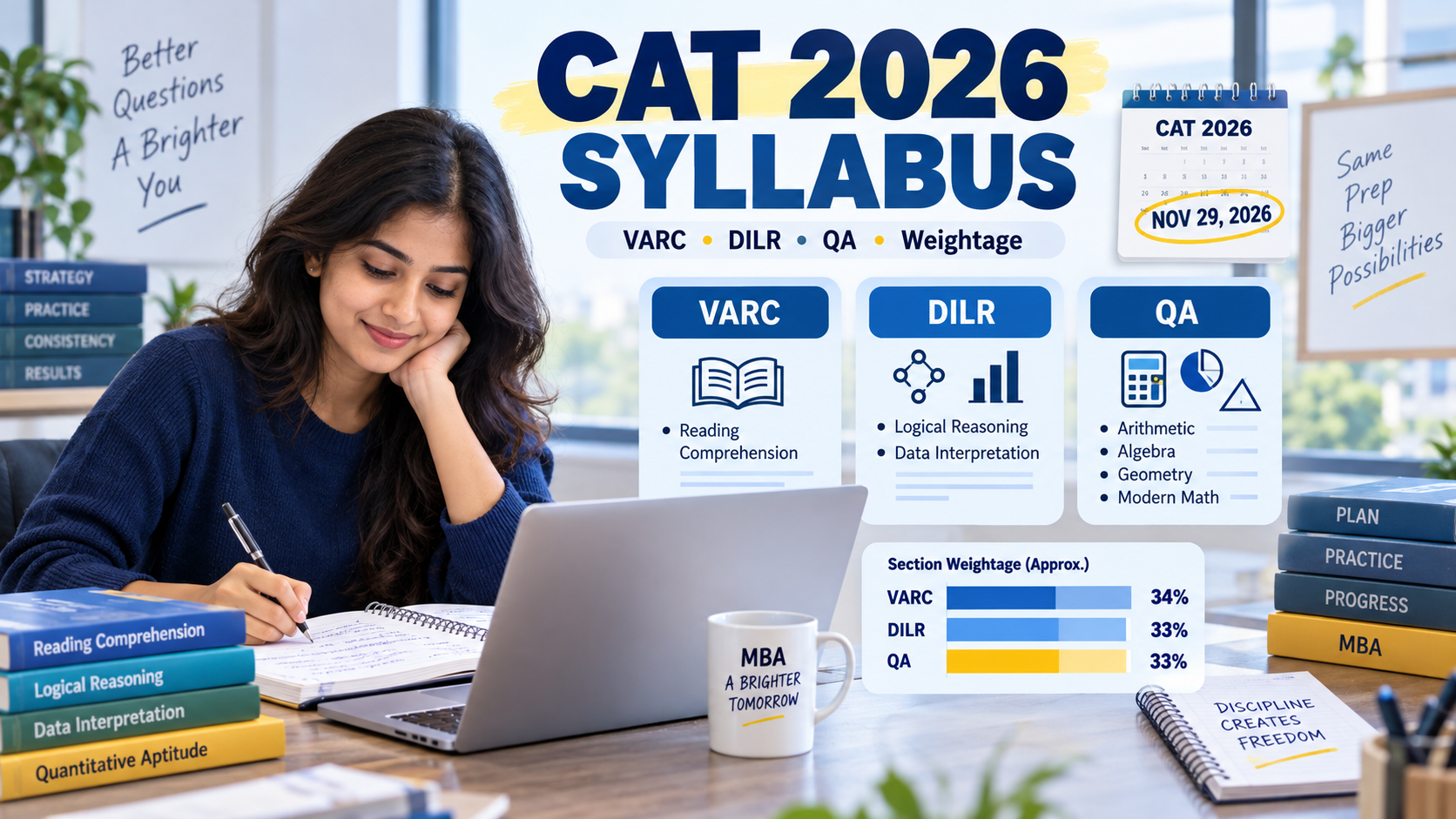
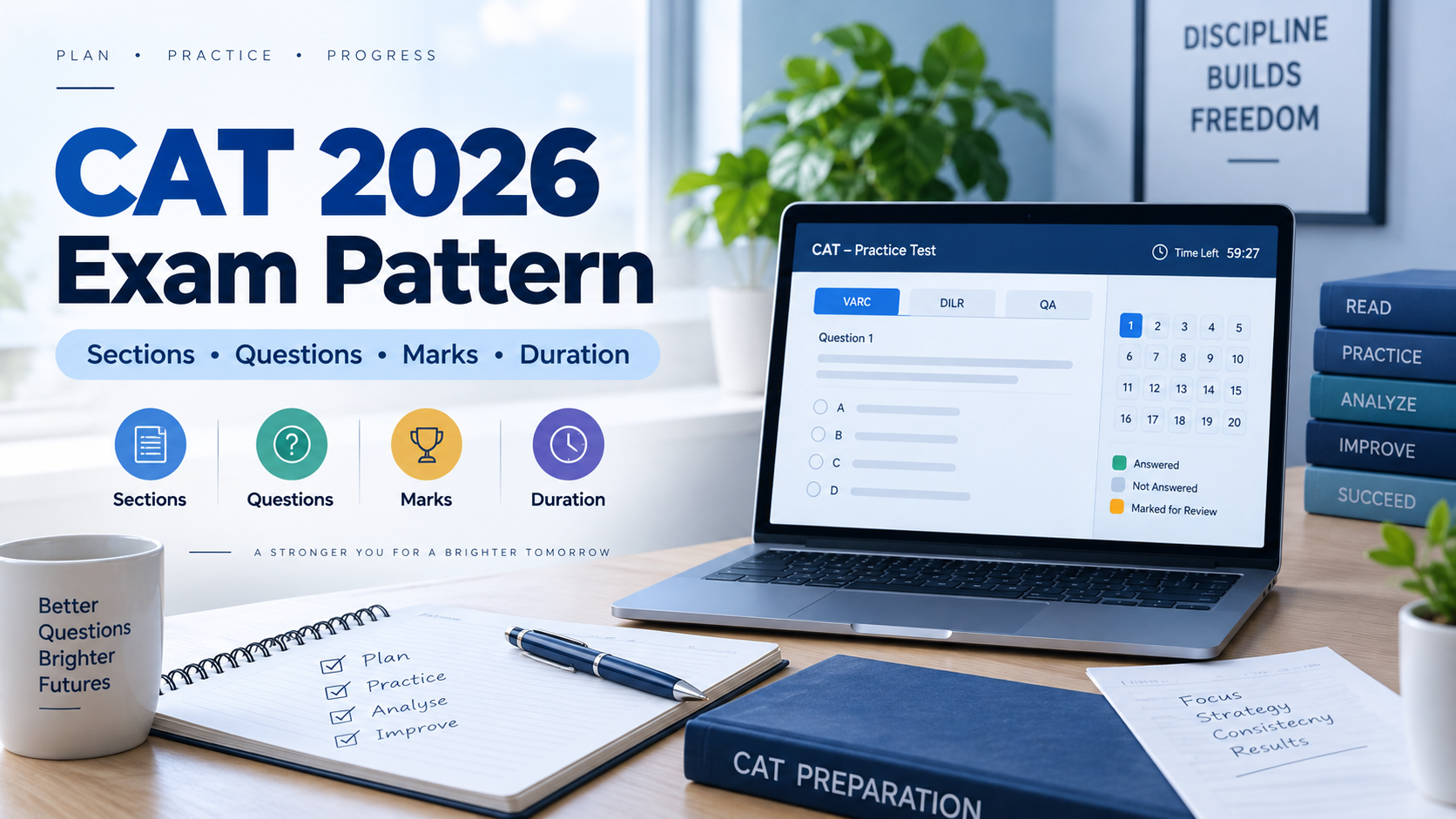
CAT has three sections: Verbal Ability and Reading Comprehension (VARC), Data Interpretation and Logical Reasoning (DILR), and Quantitative Ability (QA). Candidates need to prepare all three sections because consistently poor performance in one section can affect the overall result and sectional cutoffs.
Before starting preparation, candidates should know:
- the CAT syllabus;
- the type of questions asked in each section;
- sectional time limits;
- MCQ and TITA questions;
- marking rules; and
- the overall exam structure.
Knowing the exam pattern also helps candidates practise in the right way. CAT is not only about knowing the correct answer. Students also need to decide which questions to attempt, which ones to leave and when to move on from a difficult question.
Source: CAT 2026 Official Website
CAT 2026 Preparation Plan Based on Time Left
The time needed to prepare for CAT is different for every student. Someone who is already comfortable with reading and mathematics may need less time to build the basics, while another student may need a few extra months to strengthen Quant or VARC. Working professionals may also need to spread their preparation over a longer period because of limited weekday study time.
The preparation plan should therefore depend on both the time available and how much of the syllabus the candidate already understands.
If You Have 6 Months or More
Candidates with six months or more can spend enough time strengthening the basics before moving heavily into mocks. This is the best stage to work patiently on weak topics and develop regular practice habits.
Focus on:
- understanding the basics of all three sections;
- practising questions topic by topic;
- solving CAT previous-year questions after completing a topic;
- reading regularly for VARC;
- solving DILR sets consistently; and
- starting sectional tests gradually.
Candidates can take an occasional full-length mock to understand the exam experience, but most of the preparation at this stage should still go towards concepts and practice.
If You Have 3 to 6 Months
With three to six months left, preparation should become more practice-oriented. Important weak topics should still be covered, but students should now spend more time solving questions within a time limit.
Candidates should increase:
- sectional tests;
- CAT previous-year questions;
- mixed-topic practice;
- full-length mock tests;
- revision of weak topics; and
- review of mistakes made in tests.
This is also the stage when students should start thinking about whether a question is worth attempting in the exam. Being able to solve a question in ten minutes is different from being able to solve it quickly enough to make it a good CAT attempt.
If You Have 1 to 3 Months
With one to three months left, mocks, sectional tests and revision should take up a larger part of the preparation. Candidates should have covered most of their important concepts by this stage and should now focus on applying them under time pressure.
Priority should be given to:
- full-length mock tests;
- timed sectional tests;
- CAT previous-year papers;
- revision of important concepts;
- choosing the right questions and DILR sets;
- improving accuracy; and
- fixing mistakes that keep appearing in tests.
Trying to master every unfinished topic may not be practical at this point. It is often better to strengthen the topics that are already giving marks while improving weak areas where progress is still possible.
If You Have Less Than 1 Month
The final few weeks should be used mainly for revision, mocks and correcting repeated mistakes. Starting several completely new topics at this stage can take time away from areas that are already capable of producing marks.
Candidates should concentrate on:
- revising formulas and important concepts;
- solving previously incorrect questions again;
- going through notes from earlier mocks;
- practising DILR set selection;
- continuing regular VARC practice;
- taking selected mocks and sectional tests; and
- sticking to an exam approach that has worked in practice.
The aim in the final weeks is to reduce avoidable mistakes and become more consistent rather than making major changes to the preparation plan.
When Should You Start Sectional Tests and Mock Tests?
Candidates do not need to finish the entire CAT syllabus before taking sectional tests or mocks. Testing should begin once enough basic concepts are clear to make the test useful.
The following can be used as a simple guide:
| Stage | You Can Move Ahead When |
|---|---|
| Concepts to topic-wise practice | You can solve standard questions without checking notes repeatedly |
| Topic-wise practice to sectional tests | You can solve a reasonable mix of easy and moderate questions on your own |
| Sectional tests to full mocks | You know most of the important concepts and can attempt a section within the time limit |
| Regular mocks | You are now losing more marks because of time, accuracy or question selection than completely unknown topics |
| Final revision | You know your stronger areas, common mistakes and preferred way of attempting each section |
These stages do not have to happen at exactly the same time for all three sections. A student may be ready for full VARC sectionals while still working on Algebra or Geometry in QA.
CAT 2026 Section-Wise Preparation Strategy
VARC, DILR and QA need different preparation methods. VARC depends heavily on reading and choosing the right answer option, DILR requires students to understand and select sets quickly, while QA requires clear concepts and regular problem solving.
How to Prepare for CAT VARC 2026
VARC preparation should focus on understanding passages, accuracy and choosing between similar answer options. Reading faster can help, but speed is useful only when the passage is understood properly.
Candidates should regularly practise passages from different subjects and learn to identify the author’s main point, tone and purpose. After checking answers, students should also understand why the other options are incorrect instead of only looking at the correct option.
A good VARC routine should include:
- regular Reading Comprehension practice;
- passages from different subjects and writing styles;
- Para Summary and other VA questions;
- timed sectional tests;
- checking RC and VA accuracy separately; and
- reviewing questions where two options looked equally correct.
If two options often seem equally convincing, go back to the passage and find the line or idea that supports one option more clearly. This can help improve accuracy over time.
How to Prepare for CAT DILR 2026
DILR improves mainly through regular practice. Candidates need to become comfortable with different types of sets and learn how to arrange information using tables, diagrams, cases or simple notes.
Choosing the right set is just as important as solving it. A student may be capable of solving a difficult set but still lose valuable time if an easier set was available elsewhere in the section.
DILR practice should include:
- different types of DI and LR sets;
- trying to solve a set before looking at the solution;
- using tables, diagrams and cases to organise information;
- timed sectional tests;
- noting how much time was spent on a set that was eventually left;
- comparing different ways of solving the same set; and
- trying difficult sets again after understanding the solution.
After every sectional test, check not only how many sets were solved but also whether the easiest or most manageable sets were identified early enough.
How to Prepare for CAT Quantitative Ability 2026
QA preparation should begin with understanding the concept and then move quickly into question practice. Memorising a formula is not enough if the candidate cannot recognise when to use it in a CAT question.
A simple QA preparation order is:
Learn the Concept → Solve Basic Questions → Practise CAT-Level Questions → Solve PYQs → Take Timed Tests → Revise
Candidates should keep aside questions that taught them a new method, exposed a weak concept or took much longer than expected. These questions are useful for revision later.
QA preparation can be divided into three broad steps:
- Build the basics: Understand formulas, concepts and standard methods.
- Practise questions: Move from easier questions to CAT-level questions.
- Improve question selection: Learn which questions can be solved accurately without spending too much time.
Candidates who are weak in mathematics should not spend months only watching basic lessons. Start solving questions alongside the concepts so that the learning gradually moves towards CAT level.
How Many Hours Should You Study for CAT 2026?
There is no fixed number of study hours that guarantees a high CAT percentile. The amount of time required depends on the student’s current level, weaker sections, available preparation time and consistency.
Two focused hours of solving questions and reviewing mistakes can be more useful than spending several hours moving between videos, books and notes without enough practice.
Study time should include a mix of:
- learning concepts;
- solving questions;
- RC and DILR practice;
- sectional tests;
- full-length mocks;
- checking mistakes; and
- revision.
Study Plan for College Students
College students can spread CAT preparation around classes, assignments and examinations instead of trying to follow the same timetable every day.
A practical routine can include:
| Area | Regular Focus |
|---|---|
| VARC | RC and VA practice |
| DILR | Regular set practice |
| QA | Concepts and question practice |
| Revision | Formulas and previously incorrect questions |
| Tests | Sectional tests and mocks as preparation improves |
Weekends or lighter college days can be used for longer tests and detailed review.
Study Plan for Working Professionals
Working professionals usually have less time on weekdays, so a weekly plan is often easier to follow than a strict daily timetable.
A practical routine can be:
Weekdays
- one focused concept or question-practice session;
- a shorter VARC or DILR session; and
- quick revision of earlier mistakes.
Weekends
- a mock or sectional test;
- detailed review of the test;
- longer QA or DILR practice; and
- planning the topics to cover during the following week.
Missing one day should not disturb the entire preparation plan. Regular preparation over several weeks matters more than following every day’s timetable perfectly.
How to Use CAT Previous Year Question Papers
CAT previous-year questions help candidates understand the actual level and style of questions asked in the exam. They can be used differently depending on how far preparation has progressed.
A useful approach is:
- Topic-wise PYQs while learning and practising individual topics;
- section-wise PYQs after the basics of a section are clear;
- complete previous papers for timed practice; and
- second attempts to check whether earlier mistakes have been corrected.
Do not use every recent CAT paper early in the preparation. Keeping a few recent papers unseen makes them more useful later when they can be attempted like full mock tests.
Candidates can use the CAT Previous Year Question Papers page for year-wise and section-wise CAT papers.
CAT Mock Test Strategy: When and How to Take Mocks
Mock tests help students practise the actual skills needed during CAT: choosing questions, managing time, maintaining accuracy and deciding when to leave a difficult question.
Candidates can start taking occasional mocks even if a few topics are still unfinished. Early mocks show which sections need more work, while later mocks help improve the way the paper is attempted.
While reviewing mocks, check:
- section-wise accuracy;
- number of questions attempted;
- questions that should have been attempted but were missed;
- time spent on questions that were eventually left;
- DILR set selection;
- RC accuracy;
- strong and weak QA topics; and
- whether scores are becoming more consistent.
There is no compulsory number of mock tests that every CAT aspirant needs to take. A smaller number of mocks that are properly reviewed can be more useful than taking test after test without learning from them.
Once the official CAT 2026 mock is released, candidates should also use it to become familiar with the official exam screen, navigation and question format.
How to Analyse a CAT Mock Test
After a mock, do not look only at the overall score or percentile. Go through the paper and understand where marks were lost and what can be improved before the next test.
A simple way to review questions is:
| What Happened | What It Means | What to Do Next |
|---|---|---|
| Correct and solved quickly | Strong area | Keep practising |
| Correct but took too long | Speed needs improvement | Look for a shorter method |
| Wrong because concept was unclear | Topic needs revision | Revise and solve more questions |
| Wrong because of calculation/reading mistake | Avoidable error | Solve again carefully |
| Left but could have been solved | Question selection needs work | Improve first-round scanning |
| Attempted but consumed too much time | Wrong question choice | Learn to leave earlier |
VARC Mock Analysis
Check whether wrong answers came from:
- misunderstanding the passage;
- eliminating the wrong option;
- reading more into the passage than what was written;
- rushing; or
- attempting too many questions with low accuracy.
DILR Mock Analysis
Check:
- which set was attempted first;
- whether an easier set was left;
- how much time was spent before leaving a difficult set; and
- whether the information could have been arranged in a simpler way.
QA Mock Analysis
Separate wrong or missed questions into:
- topics that need revision;
- calculation mistakes;
- questions where the method was too slow;
- questions that should have been left; and
- easier questions that were not reached.
After reviewing the mock, decide what needs to be done before the next one. For example, revise percentages, solve five similar DILR sets or practise RC option elimination. A clear next step is more useful than simply deciding to “practise more”.
CAT Preparation Without Coaching: Is Self-Study Enough?
CAT can be prepared through self-study if candidates have good learning material, enough practice questions, previous-year papers and a reliable mock-test series.
Coaching can provide classes, schedules and teacher support, but students preparing on their own can also build a structured routine by limiting the number of resources and practising consistently.
For self-study, candidates mainly need:
- one reliable source for learning each section;
- CAT previous-year papers;
- sectional tests;
- a mock-test series;
- notes of repeated mistakes;
- short revision notes; and
- regular VARC and DILR practice.
One common self-study problem is collecting too many books, courses and video playlists. It is usually better to complete and revise one good resource before moving to another.
What Study Material Do You Need for CAT 2026?
CAT preparation does not require several books for every section. Each resource should serve a clear purpose.
| Resource | Main Use |
|---|---|
| Concept book or course | Learn the basics |
| Topic-wise question bank | Practise individual topics |
| CAT PYQs | Practise actual CAT questions |
| Sectional tests | Improve section-wise speed and accuracy |
| Full mock tests | Practise the complete exam |
| Mistake notes | Revise repeated errors |
| Formula/revision notes | Quick revision |
Candidates who prefer books can choose one reliable CAT-level book for each section and add another only if the first resource does not provide enough practice in a particular area.
Should You Complete the Entire CAT Syllabus Before Taking Mocks?
No. Candidates should try to cover most of the syllabus, but there is no need to wait until every topic is finished before taking sectional tests or full-length mocks.
A topic should not be considered complete just because a lecture or chapter has been finished. Students should also be able to solve questions from it.
A useful order is:
Learn → Practise → Solve PYQs → Solve Under Time Limit → Revise
If time is limited, candidates should give more attention to:
- strong topics that can provide reliable marks;
- weak topics where improvement is still possible;
- topics that appear regularly in CAT-level practice; and
- areas that repeatedly lower sectional or mock scores.
The goal is to become comfortable with a broad range of CAT questions rather than trying to become perfect at every topic.
How to Know Whether Your CAT Preparation Is Improving
Do not judge preparation only by the number of hours studied or chapters completed. Look at whether actual test performance is improving.
Check these points every week:
| What to Check | What Improvement Looks Like |
|---|---|
| VARC accuracy | More correct answers at a similar number of attempts |
| DILR practice | More sets solved without checking the solution |
| QA accuracy | Familiar topics are being solved faster and with fewer mistakes |
| Sectional scores | Scores are becoming more stable |
| Mock scores | Improvement is visible across several mocks, not just one |
| Repeated mistakes | The same errors are happening less often |
| Question selection | Less time is being wasted on questions that are eventually left |
If the same problem keeps appearing for several weeks, change the way that area is being practised instead of simply increasing study hours.
Common CAT Preparation Mistakes
CAT preparation can become inefficient when students spend a lot of time studying but do not check whether their scores, accuracy or speed are improving.
Common mistakes include:
- collecting too many books and courses;
- waiting to finish the entire syllabus before taking tests;
- spending too much time on theory and too little on questions;
- taking mocks without reviewing them properly;
- ignoring a weak section;
- practising only favourite topics;
- changing the entire approach after one poor mock;
- spending too much time on difficult questions;
- memorising PYQ solutions;
- using all recent CAT papers too early; and
- constantly comparing preparation with other students.
As preparation progresses, students should gradually find the approach that works best for them instead of copying another candidate’s timetable or number of attempts.
Last-Month CAT Preparation Strategy
The final month should focus mainly on revision, mock tests and correcting repeated mistakes. Candidates should avoid trying to finish large amounts of completely new material at this stage.
Use the final month to:
- revise formulas and important weak topics;
- go through mistakes noted from earlier mocks;
- solve selected incorrect questions again;
- practise choosing DILR sets quickly;
- continue regular VARC practice;
- take selected mocks and sectional tests; and
- avoid unnecessary changes to an approach that is already working.
The goal before the exam is to know your stronger areas, common mistakes and preferred way of attempting each section.
Also Read:
CAT 2026 Exam Pattern: Sections, Questions, Marks, Duration & Marking Scheme
CAT 2026 Syllabus: VARC, DILR & QA Topics, Weightage
CAT 2026 Preparation FAQs
Is six months enough to prepare for CAT?
Six months can be enough for many candidates, but it depends on the student’s starting level and consistency. Someone with strong basics may move into mocks sooner, while a candidate who is weak in Quant or reading comprehension may need more time for concepts and practice.
Can an average student crack CAT?
Yes. A student does not need to have been a school or college topper to perform well in CAT. Regular practice can improve concepts, accuracy, speed and question selection. However, no study plan can guarantee a particular percentile.
What should I do if my CAT mock scores keep going up and down?
Do not judge preparation from one mock. Compare several tests and check which section is causing the biggest change in scores. Look at accuracy, DILR set selection, QA topics and the number of questions attempted. The aim should be to make performance more consistent over time.
Should I skip a CAT topic if I find it very difficult?
Do not leave a topic immediately. Learn the basics and try standard questions first. If time is limited and the topic continues to take too much effort for very little improvement, you can give more time to stronger topics while keeping a basic understanding of the difficult area.
Should I buy two CAT mock-test series?
One good mock series is enough to start. A second can be considered later if most tests from the first series have been used properly and more fresh mocks are needed. Buying several mock series at the beginning often leaves students with more tests than they can realistically attempt and review.